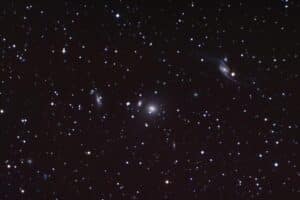
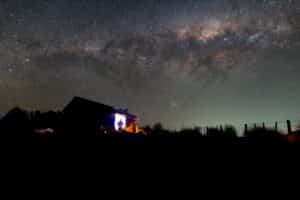
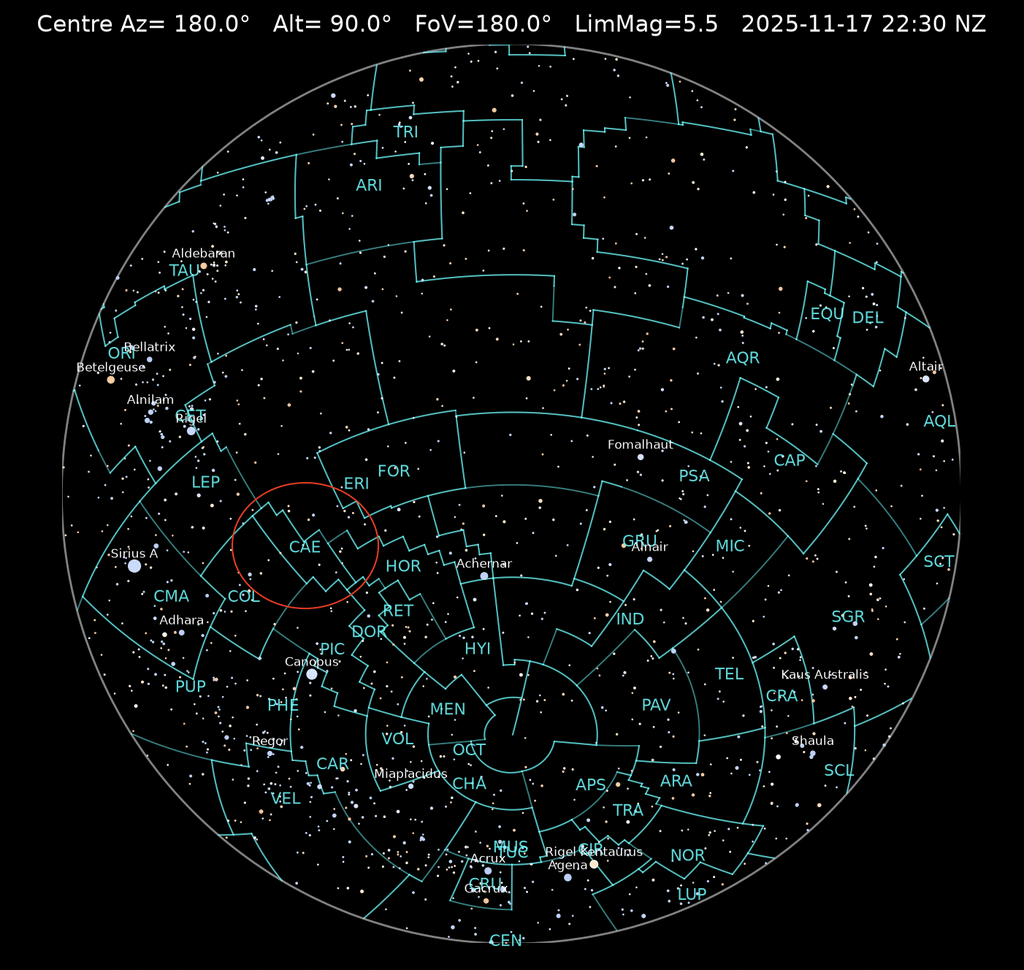
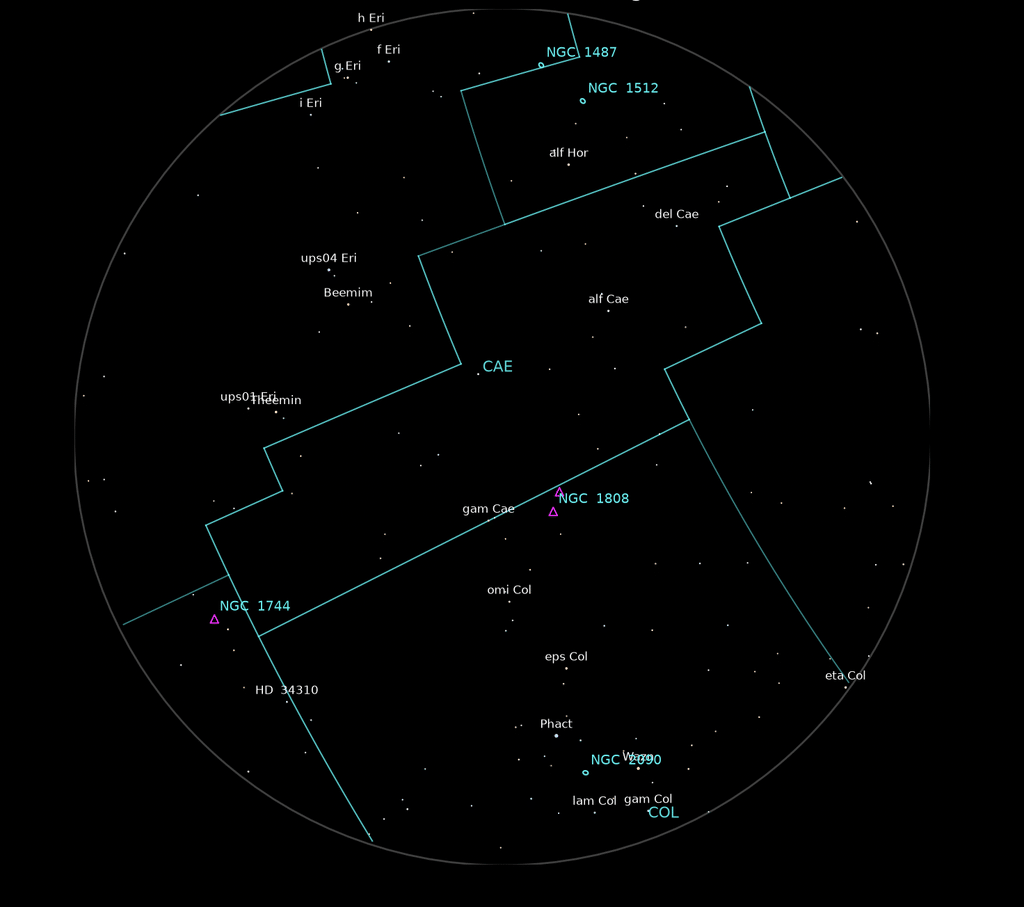
Caelum is tucked away in a relatively inconspicuous part of the southern sky, between the constellations of Eridanus and Columba. From Star Safari Observatory, Caelum is visible in the late evening from November. It is best placed for viewing during the summer months of December, January, and February. Its brightest star is Alpha Caeli, with an apparent visual magnitude of just 4.45 (Gaia Collaboration, 2020). Caelum can be challenging to identify with the naked eye, particularly when moonlight brightens the night sky and reduces the contrast between the stars and their surroundings (Krisciunas & Schaefer, 1991). It is one of those constellations we tend to overlook in favour of its more prominent neighbours. Behind this seemingly unremarkable patch of sky lies a fascinating story of scientific exploration and how humans have mapped and interpreted the sky.
How Do You Say Caelum?
Pronouncing constellations and star names is tricky, partly because spellings change a lot and interpretations of how the original language pronounced them get lost. Caelum derives from Latin, so that should probably be the best guide for pronunciation. In Classical Latin, the c is a hard k, and the diphthong ae is like “eye”, and the lum is a bit like loom (Allen, 1978, p.60). So if you pronounce it like that, then you’re not technically wrong. The modern accepted English pronunciation is the cae sounding like “see”, with the lum being how you would pronounce lum in English rather than loom. So both versions are quite different and quite correct.
In Antiquity?
The stars of Caelum are not very prominent, and though they were probably visible to Ptolemy, they didn’t make it into his catalogue (Verbunt & van Gent, 2012, p28), nor Ulugh Beg’s of 1437 (Verbunt & van Gent, 2012, p1). They also don’t make it to Tycho Brahe’s catalogue, even though a few nearby stars of Eridanus do (Verbunt & van Gent, 2010, p22),. So it comes as no surprise that the stars of Caelum did not feature in any European-centric tradition, most likely because of their brightness and very southerly position in the sky, especially from Brahe’s observation site where they would not have been visible (Thoren & Wilson, 1991).
Map
Who gets naming rights?
Often, constellation and star names are assumed to be inspirational; more often than not, it comes down to who wrote it down and who kept using the name. As seen with the naming of Pavo, it’s a bit of luck and mostly about timing as to who got to decide the common names we use today. The stars of the Southern Hemisphere began appearing on European star maps not long after Europeans ventured to Southeast Asia and Africa. One of the leading astronomers of the mid-1700s was Nicolas-Louis de Lacaille, who named 14 (de La Caille, 1752) of the current 88 constellations recognised by the International Astronomical Union (IAU).
La Caille ventured to the Cape of Good Hope and stayed there from 1751 to 1753; during this time, he observed many southern stars with his modest 13mm telescope mounted on an astronomical quadrant (Warner, 2002). He did remarkable work with his modest telescope, surveying just under 10,000 stars from 6 August 1751 to 18 July 1752 (La Caille, 1756). He originally designated the stars now known as Caelum as Les Burins, meaning engraving tools. The word Caelum refers to one type of engraving tool, like a chisel.
Why a Chisel
Lacaille’s choice of an engraving tool to represent this small collection of stars reflects eighteenth-century intellectual and technological culture. In the concluding remarks of his 1756 publication, La Caille explained that he had introduced new constellations to fill the large spaces between the ancient constellation figures, choosing to represent the principal instruments of the arts (La Caille 1756).
Caelum was not depicted as a single chisel, but as two engraver’s instruments, a burin and an échoppe, crossed and tied together with a ribbon. These tools produced engraved illustrations, an important way to disseminate scientific knowledge before photography. This was a big deal back then, so immortalising these tools makes sense. Alongside the telescope, microscope, pendulum clock, and painter’s easel, Caelum represents a departure from the mythology of the ancient constellations toward a recognition of the tools of science, or at least the tools used to disseminate science.
Simplifying the Night Sky
Standardisation of European names for constellations and stars began in 1840, when the British Association For The Advancement of Science established a committee to review them. They recommended significant changes but backed off due to resistance from European continental astronomers (Herschel, 1844, p.60). John Herschel’s motivation for reforming the names and boundaries of the constellations was to make it easier for astronomers to use catalogues of stars and deep sky objects (Case, 2015, p.428). Case (2015, p428) found this telling quote from Herschel’s writings:
“Of course we do not here speak of those uncouth figures and outlines of men and monsters, which are usually scribbled over celestial globes and maps, and serve, in a rude and barbarous way, to enable us to talk of groups of stars, or districts in the heavens, by names which, though absurd or puerile in their origin, have obtained a currency from which it would be difficult, and perhaps wrong, to dislodge them. Inso far as they have really (as some have) any slight resemblance to the figures called up in imagination by a view of the more splendid ‘constellations’, they have a certain convenience; but as they are otherwise entirely arbitrary, and correspond to no natural subdivisions or groupings of the stars, astronomers treat them lightly, or altogether disregard them.”
Olbers wrote to the Royal Astronomical Society (Olbers, 1841, p.103):
“This extravagant number of new constellations, some of which were formed of scarcely visible stars, by no means made the study of astronomy more easy, on the contrary, confused it, and rendered it more difficult.“
By the mid-1800s, discontent with the excesses of 1700s naming conventions seemed to be growing, along with a desire to tidy them up. As a result, the constellation we know as Caelum today was shortened from Caelum Sculptorium. I’m sure Olbers was referring specifically to Caelum in his quote above. I couldn’t find any specific references to who initiated the change, but it seems to rest with discussions between Herschel and Bailey (Ennis, 2025, p.307). In fact, Ennis (2025, p.307) offers an incredible description of how the name developed through various sources in the 1700s and 1800s for readers who want more information.
The Stars of Caelum
Since there isn’t much else to see in Caelum, the stars are the highlight, and it contains some very interesting ones.
Alpha Caeli is the constellation’s brightest star and a binary system located about 66 light-years from Earth. Its primary component is an F2 V main-sequence star, meaning it generates energy through hydrogen fusion in its core. It is hotter and more luminous than the Sun, with an effective temperature of approximately 7,000 K. Its companion is a much fainter red dwarf with a visual magnitude of approximately 12.5.
Beta Caeli is another yellow-white F-type star, situated approximately 94 light-years away. Its spectral classification varies between F3 V and F3 IV in the literature, suggesting it is either a main-sequence star or a star beginning to evolve off the main sequence. It is also a probable spectroscopic binary, making it another example of a star that appears solitary to the naked eye but may consist of two stars orbiting one another.
Gamma Caeli is actually a binary system: Gamma¹ and Gamma². They are separated by approximately 0.22 degrees on the sky. Gamma¹ Caeli is an evolved orange giant of spectral type K2 III–IIIb, approximately 185 light-years away. Gamma² Caeli is considerably fainter and more distant, and is particularly interesting because it is a pulsating variable star known as X Caeli. The two systems are not physically associated; their proximity is a line-of-sight effect.
References
Allen, WS 1978, Vox Latina: A Guide to the Pronunciation of Classical Latin, 2nd edn, Cambridge University Press, Cambridge.
Case, S 2015, ‘‘Land-marks of the universe’: John Herschel against the background of positional astronomy’, Annals of Science, vol. 72, no. 4, pp. 417-34.
Ennis, C 2025, World Asterisms Project: An Introduction to the Sky Cultures of the World, Version 2025.14 edn, vol. 1, Royal Astronomical Society of Canada, Sunshine Coast Centre.
Gaia Collaboration, 2020, ‘Vizier online data catalog: Gaia edr3 (gaia collaboration, 2020)’, VizieR Online Data Catalog, vol. 1350, p. I/350.
Glass, IS 2012, ‘Nicolas-Louis De La Caille, Astronomer and Geodesist: South African Astronomical Observatory’.
Herschel, JF 1844, ‘Further remarks on the revision of the constellations’, Monthly Notices of the Royal Astronomical Society, vol. 6, p. 60.
Krisciunas, K & Schaefer, BE 1991, ‘A model of the brightness of moonlight’, Publications of the Astronomical Society of the Pacific, vol. 103, no. 667, pp. 1033-9.
de La Caille, N-L 1752, Table des ascensions droites et des déclinaisons apparentes des étoiles australes renfermées dans le tropique du Capricorne, observées au cap de Bonne-Espérance, dans l’intervalle du 6 août 1751 au 18 juillet 1752, par M. l’abbé de La Caille, éditeur non identifié.
Olbers, W 1841, ‘On a Reformation of the Constellations, and a Revision of the Nomenclature of the Stars’, Monthly Notices of the Royal Astronomical Society, Vol. 5, p. 101-120, vol. 5, pp. 101-20.
Thoren, VE & Wilson, C 1991, The lord of Uraniborg: a biography of Tycho Brahe, American Institute of Physics, 0031-9228.
Verbunt, F & van Gent, RH 2012, ‘The star catalogues of Ptolemaios and Ulugh Beg: Machine-readable versions and comparison with the modern Hipparcos Catalogue’, Astronomy & Astrophysics, vol. 544, p. A31.
Verbunt, F & van Gent, RH 2010, ‘Three editions of the star catalogue of Tycho Brahe: Machine-readable versions and comparison with the modern Hipparcos catalogue’, Astronomy & Astrophysics, vol. 516, p. A28.
Warner, B 2002, ‘Lacaille 250 years on’, Astronomy & Geophysics, vol. 43, no. 2, pp. 2.25-2.6.